

What is NoOps and How to Achieve NoOps in Mobile App Development?
Why NoOps Matters in Mobile App Development
- Eliminate operational bottlenecks.
- Reduce human errors and improve reliability.
- Accelerate app delivery cycles without compromising security or performance.
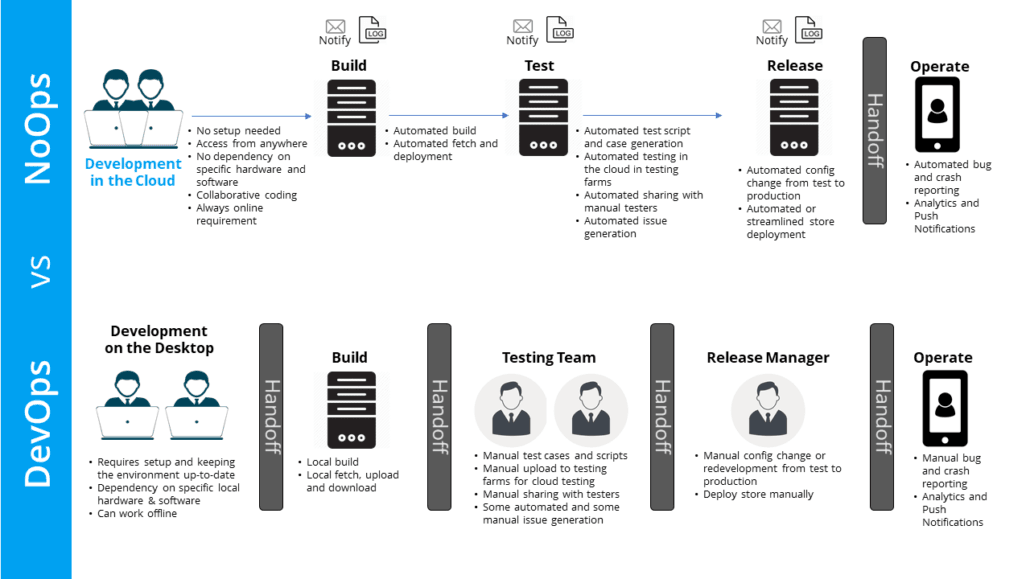
DevOps vs. NoOps: A Comparison
Aspect | DevOps | NoOps |
Approach | Collaboration between Dev and Ops | Fully automated, no manual Ops |
Use Case | Complex, customizable pipelines | Streamlined, automated workflows |
Flexibility | High for tailored setups | Moderate, ideal for automation |
Scalability | Requires manual oversight | Fully automated scaling |
While DevOps remains a staple for many enterprises, NoOps offers a natural progression for teams seeking simplicity and efficiency.
DevOps in Enterprise Mobility
- Automate app build and deployment processes.
- Enhance collaboration between developers and IT operations.
- Maintain compliance and security standards.
- Scale app distribution across diverse devices and platforms.
How to Achieve NoOps in Mobile Development
- Adopt Serverless Architectures: Use services like AWS Lambda or Google Cloud Functions to eliminate server management complexities.
- Leverage CI/CD Platforms: Tools like Appcircle provide end-to-end automation for building, testing, and deploying mobile apps.
- Implement Infrastructure as Code (IaC): Tools like Terraform automate infrastructure provisioning, ensuring consistency across environments.
- Integrate Monitoring Solutions: Tools like Datadog and New Relic provide real-time performance insights, enabling proactive issue resolution.
NoOps with Appcircle
- Automated Workflows: Eliminate the need for manual configurations with Appcircle’s drag-and-drop workflow builder.
- Centralized Management: Securely manage signing identities, build artifacts, and environment variables in one place.
- Secure Builds: Each build is executed in an isolated environment, ensuring complete data privacy.
- Seamless App Distribution: Automate app distribution to app stores or internal teams with just a few clicks.


Benefits of Adopting NoOps in Mobile Development
- Faster Time-to-Market: Automation accelerates development cycles, allowing teams to deliver apps quickly.
- Reduced Operational Overhead: NoOps eliminates manual processes, freeing up resources for core development tasks.
- Improved Reliability: Automated workflows minimize errors and ensure consistent performance.
- Scalability: NoOps environments adapt effortlessly to changing workloads, supporting enterprise growth.
Conclusion
FAQs
1. What is the meaning of NoOps?
NoOps (No Operations) refers to a highly automated development environment where operational tasks such as infrastructure provisioning, monitoring, and deployment are fully automated, minimizing or eliminating the need for a dedicated operations team. The goal is to let developers focus exclusively on building software.
2. What is NoOps in DevOps?
NoOps is considered a natural evolution of DevOps. While DevOps emphasizes collaboration between development and operations teams, NoOps takes this a step further by fully automating operational tasks. In a NoOps setup, developers can deploy, manage, and monitor applications without depending on a separate operations team.
3. What is the difference between ZeroOps and NoOps?
Although closely related, the key difference lies in the scope of automation. NoOps still allows for some human involvement in exceptional scenarios, while ZeroOps aims for complete automation, including self-healing and autonomous responses to infrastructure needs. ZeroOps is still an emerging approach and not yet widely adopted, aiming to create a fully self-sufficient software environment.

