
White-Label Mobile App CI/CD for Enterprises
White-label mobile applications have become a cornerstone strategy for software vendors serving enterprise clients. From fintech platforms powering banking apps to healthcare solutions and logistics systems, the white-label model enables vendors to maintain a single codebase while generating customized builds for each client, with unique branding, configurations, and compliance requirements.
However, generating customized builds for multiple clients from a single codebase comes with significant complexity. Managing dozens or even hundreds of client-specific configurations, code-signing assets, environment variables, and delivery pipelines can quickly become overwhelming without the right white-label CI/CD strategy.
This guide explores the unique challenges of white-label mobile app CI/CD and provides practical solutions for enterprise teams looking to scale their delivery operations efficiently.
Understanding White-Label Mobile App Architecture
White-label mobile applications share a common codebase while supporting extensive customization for each client. This typically includes:
- Visual branding elements (logos, color schemes, themes)
- Functional configurations (API endpoints, feature flags, business logic parameters)
- Platform-specific app identifiers (package/bundle IDs) and app naming
- Client-specific code signing assets and store accounts
- Dedicated build configurations and workflows per client
For enterprises, especially in regulated industries like fintech and healthcare, white-label apps are a popular choice for scaling mobile solutions across multiple clients. However, this model introduces critical security and governance considerations, including how signing assets are managed across iOS (certificates, provisioning profiles) and Android (keystores), how store credentials are handled, and how audit trails are maintained across organizations.
Challenges of White-Label Mobile App CI/CD
Traditional CI/CD pipelines assume a single app with a linear build-test-release workflow. White-label apps break this assumption fundamentally. Consider a fintech company providing mobile banking solutions to 50 different banks. Each release cycle requires building 50 separate app variants, each with its own configuration set, signing credentials, and distribution target.
Manual handling of this white-label CI/CD process introduces several pain points:
- Configuration explosion: Every client increases the number of build variants, environment variables, and workflow conditions. Without a structure, the pipeline turns into a fragile matrix.
- Signing ownership and compliance: In many enterprise scenarios, customers require binaries signed with their own signing assets and published using their own store credentials. That creates a secure handoff problem.
- Distributing binaries: Each customer has separate testers, device lists, release frequency, and compliance gates. A single shared testing process rarely works.
- Release governance and auditability: Enterprises care about who triggered what, who signed what, what changed, and when it was released. You need traceability across build, distribution, and publishing.
The solution lies in designing mobile CI/CD pipelines specifically architected for white-label app workflows, with clear separation of concerns between the vendor’s build operations and each client’s distribution and release processes. For teams working with external partners, see our Outsourcing Mobile App Development: 5 Critical Factors to Consider blog for a detailed governance checklist.
White-Label Mobile CI/CD Architecture with Appcircle
Let’s examine how a real enterprise white-label app flow operates in Appcircle with a multi-organization architecture designed for clear ownership and governance. This pattern is particularly common in fintech, where a software vendor provides mobile banking solutions to multiple financial institutions.
The Scenario
Consider a fintech company that develops white-label mobile banking applications. They serve multiple banks, each requiring their own branded app with specific configurations, signing assets, and app store accounts.
Architecture Overview
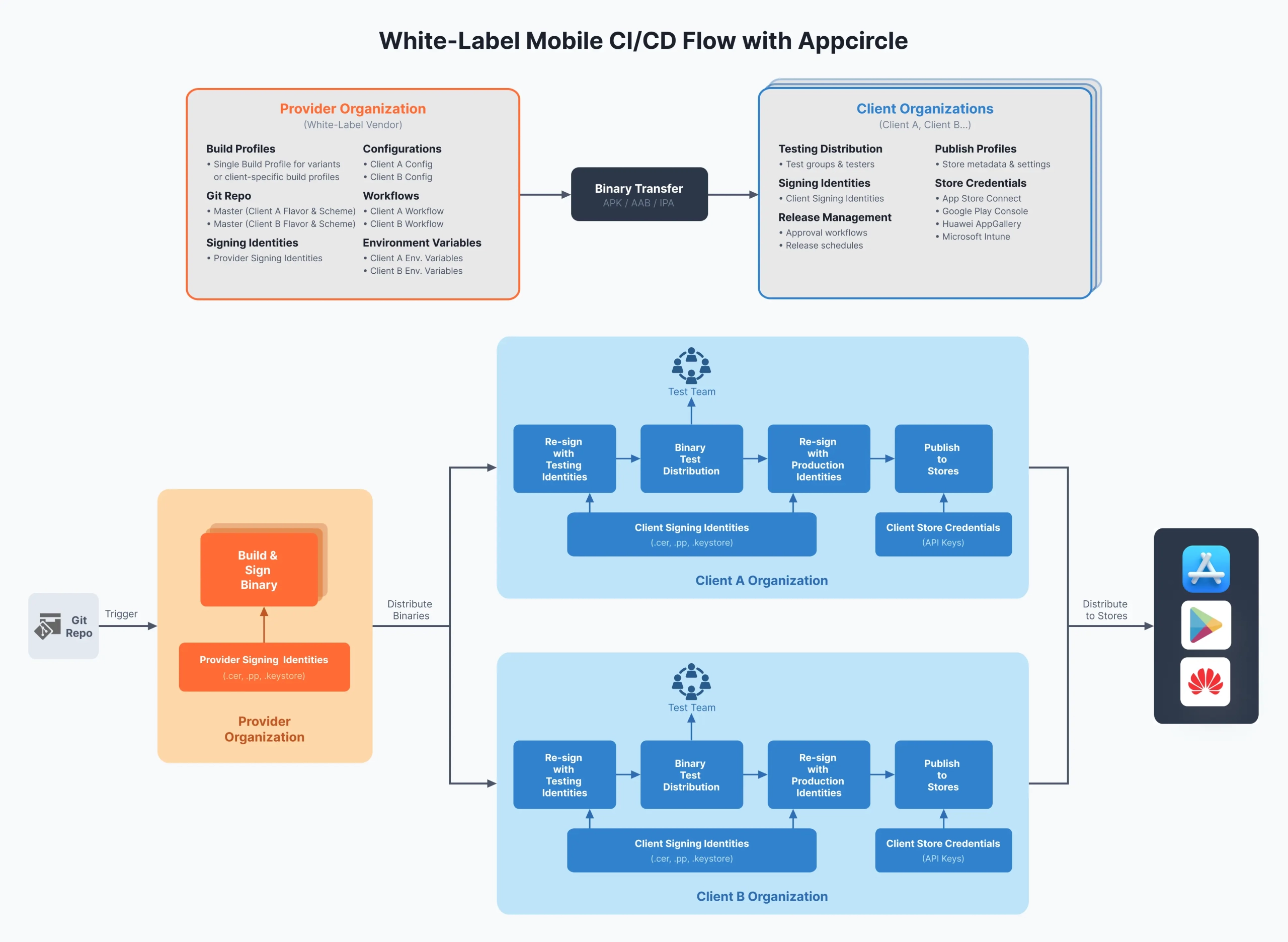
This architecture separates the Provider organization from Client organizations, each with distinct responsibilities.
Provider Organization (White-Label Vendor)
The provider handles all development and build operations:
- Build Profiles: Either a single build profile that produces multiple client variants through workflows and configurations, or separate client-specific build profiles (Bank A, Bank B, etc.)
- Git Repository Connection: Source repository with client-specific build flavors (Android) and schemes (iOS)
- Signing Identities: Initial code signing with provider’s own signing assets
- Configuration Management: Separate configurations for each client bank
- Workflow Management: Dedicated workflows for each client with appropriate build steps
- Environment Variables: Client-specific variables for each release target
When the provider team triggers a build on the master branch, the CI/CD pipeline produces client-specific APK, AAB, or IPA files. These binaries are then distributed to each client’s organization via Appcircle’s API or CLI.
Client Organization (Each Bank)
The client organization receives the app binary and takes over the distribution and release process:
- Testing Distribution: Binary arrives in the bank’s Testing Distribution module
- Auto Re-sign for Testing: App is automatically re-signed with the bank’s own testing signing identities
- Test Distribution: App is distributed to the bank’s test/QA team
- Auto Re-sign for Production: After testing approval, app is automatically re-signed with the bank’s own production signing identities
- Store Publishing: The bank operator triggers the release flow and app is pushed to stores using the bank’s own store credentials (App Store Connect, Google Play, Huawei AppGallery, or Microsoft Intune via API keys) Alternatively, builds can be sent directly to TestFlight or Google Play testing tracks, bypassing internal test distribution.
Key Benefits of the White-Label Mobile CI/CD Architecture
This multi-organization model delivers significant advantages:
- Security boundaries: Each organization has isolated access to its own signing identities (iOS certificates & provisioning profiles, Android keystores) and store credentials. Since the binary is re-signed with the client’s own signing identities, the final application is fully under client control.
- Compliance satisfaction: Clients maintain complete control over their app release process, with providers responsible only for building and delivering binaries. Audit trails remain within each organization, ensuring clear accountability for regulated industries.
- Reduced risk and liability: Client-sensitive assets such as store credentials and signing identities remain within client organizations and are never shared with the provider. This reduces credential exposure and simplifies compliance requirements for both parties.
- Operational independence: Clients can run their own testing cycles and release schedules without depending on the vendor. They always have access to the latest version from master and can release whenever they’re ready.
- Centralized app development: All source code, build logic, and core configurations are managed by the vendor, ensuring consistency and enabling efficient updates.
- Scalability: Onboarding new clients is straightforward without restructuring the existing pipeline, and concurrent builds allow generating binaries for multiple clients simultaneously.


Conclusion
White-label mobile app CI/CD for enterprises requires detailed architecture that addresses the unique challenges of multi-client app delivery. The separation of build and distribution helps providers scale development across many clients. At the same time, clients keep full control of their signing identities and store credentials. This protects security boundaries and supports compliance.
By implementing the patterns and practices outlined in this guide (such as centralized app development, automated re-signing, and clear organizational boundaries), enterprise teams can achieve the efficiency and reliability that modern mobile app delivery demands.
The key is choosing a CI/CD platform like Appcircle, designed with this enterprise white-label mobile app architecture in mind. It offers the flexibility to adapt to your specific organizational structure while providing the automation and security controls necessary for regulated industries.
FAQs
1. What is white-label mobile app CI/CD?
White-label CI/CD refers to automating the build, test, and release processes for apps that share a common codebase but are customized and rebranded for multiple clients. It involves managing client-specific configurations, branding assets, signing credentials, and distribution channels within a unified CI/CD architecture, often supported by mobile CI/CD platforms like Appcircle.
2. Why do enterprises need a dedicated CI/CD approach for white-label apps?
Because white-label delivery multiplies the number of release variants and compliance requirements. Without structured automation and governance, teams face configuration drift, signing bottlenecks, and hard-to-audit releases. Mobile CI/CD platforms like Appcircle help teams manage client-specific apps, automate re-signing, and maintain audit-ready release flows.
3. How can I manage code signing for multiple white-label clients?
The recommended approach is to separate code signing responsibilities. The provider signs binaries with their own signing identities during the build phase, then distributes to client organizations where automatic re-signing occurs with each client’s own signing identities. This ensures clients maintain full control over their signing credentials.
4. What is auto re-signing and why is it important for white-label apps?
Auto re-signing automatically applies a new code signature to an app binary when it moves between organizations. This is critical for white-label app flows because it allows providers to deliver provider-signed builds that clients can then sign with their own identities without manual intervention.
5. What are the biggest security risks in white-label mobile CI/CD?
The most common risks are sharing code signing assets such as iOS certificates and provisioning profiles and Android keystores, secret leakage due to inconsistent configuration management, and unclear release ownership. A customer-owned app signing and publishing model reduces exposure and improves auditability.
6. Does white-label app CI/CD require a monorepo pattern?
No, white-label app CI/CD does not require a monorepo pattern. You can implement a scalable white-label app delivery model with either:
- Monorepo: iOS, Android, and shared packages/tools live in a single repository.
- Multi-repo: iOS and Android (and shared libraries) are managed in separate repositories.
The key is not the repository strategy. It is having a CI/CD architecture that can reliably produce client-specific variants (configs, branding, identifiers) and enforce clear ownership boundaries for signing and publishing.
Appcircle supports both approaches. You can generate client apps from a single repository using one build profile with different workflows and configuration sets, or manage separate repositories with client-specific build profiles. In both cases, the goal is the same: scalable automation with secure, client-owned signing and publishing.

