

Comparing Appcircle and Bitrise: Which DevOps Tool Builds Faster?
In the fast-paced world of mobile app development, build time is a game changer. Lengthy build times disrupt workflows and slow down progress. The architecture of the project, the robustness of the CI/CD tools, the caching mechanism, and the underlying infrastructure all play pivotal roles in this process. At our core, we’re dedicated to refining these critical aspects to enhance your development experience.
As we wrapped up the first quarter, our mission was to boost our mobile build caching performance. We have achieved this by introducing new caching implementation methods, thereby providing a more reliable and efficient compilation environment. We are aware that CICD caching is a hot topic for Bitrise, therefore we have compared our performance with Bitrise caching.
For more detailed comparison between Appcircle and Bitrise, check out Bitrise Alternatives & Overview page.
Optimizing Mobile App Development: Cache Structure in CI/CD Tools
Cache structure is a cornerstone of mobile CI/CD tools, directly impacting performance. A well-built cache system enhances stability and speed during the compilation process. The strategy behind our caching is simple: minimize dependency download times by caching unchanged or infrequently updated elements. Once cached, all future compilations pull from this reserve unless updates occur. This method ensures only new or altered dependencies are downloaded, speedıng up compilation times significantly. With Appcircle’s robust caching, you’ll notice a marked decrease in wait times.
Comparative Speed Analysis
To gauge the effectiveness of our recent updates, we revisited our 2021 benchmark tests. This time, we pitted the Bitrise CI/CD platform against Appcircle, using identical Apple M1 4Core 6GB setups and Xcode 15.2 for both tests. The pipeline we used for testing comprises the following steps:
- Git Clone
- Cache Pull
- Cocoapods Install
- Cache Push
- Xcodebuild for Devices
- Export Build Artifacts
The project we used was XcodeBenchmark which contains a large codebase to measure the compilation time in Xcode.
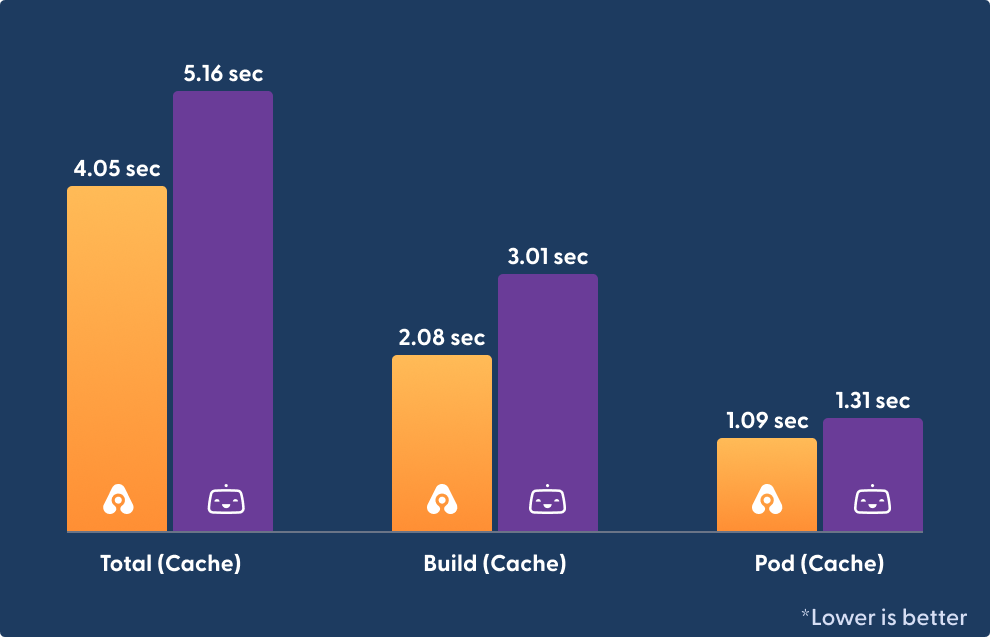
For each platform, we have run the pipeline for 10 times with caching enabled. We have taken the averages for the total time, build time, and the pod install time. Total time includes all the steps. Build time is the average time for Xcodebuild task and pod time is the average for CocoaPods install task
The results? Our latest enhancements have significantly improved Appcircle’s performance. Appcircle is now outperforming Bitrise by a significant 22%.
Conclusion
The first quarter’s upgrades have substantially boosted Appcircle’s performance, with speed improvements ranging from 20-25%. Understanding the critical importance of time, performance, and stability in the CI/CD landscape, we continually evaluate and enhance our systems. Every quarter, we audit our tools, update as necessary, and maintain our commitment to stability, ensuring you get the best possible service. In addition, we aim to provide the newest Xcode version in 48 hours after release (both for cloud and on-premise versions, so that our clients can work on the latest runtime.
*These tests were conducted at the end of Q1. If you see different results in your tests feel free to contact us at [email protected]
FAQs
1. Why is caching important in mobile CI/CD pipelines?
Caching reduces build times by reusing previously downloaded or compiled dependencies. Instead of fetching libraries or rebuilding unchanged components, the pipeline pulls them from the cache. This speeds up builds, reduces network load, and improves developer productivity.
2. How does Appcircle’s caching compare to Bitrise?
Recent benchmark tests show that Appcircle’s caching system outperforms Bitrise by about 22% in total build performance. By minimizing redundant dependency downloads and optimizing cache structure, Appcircle delivers faster build and pod install times on identical hardware setups.
3. What factors influence build time in mobile CI/CD tools?
Key factors include project architecture, the caching strategy, dependency management, infrastructure speed (e.g., Apple Silicon vs. Intel runners), and the efficiency of CI/CD steps like Git cloning, dependency installs, and Xcode builds. Tools optimized for mobile, like Appcircle, generally offer faster build times than general-purpose CI/CD platforms.
4. How does Appcircle ensure stability and performance in caching?
Appcircle uses an intelligent caching mechanism that stores unchanged dependencies and pulls them automatically for future builds. Only new or modified files are re-downloaded, making pipelines faster and more stable. Appcircle also audits and upgrades caching methods quarterly to maintain performance improvements.
5. How quickly does Appcircle support new Xcode versions compared to other CI/CD tools?
Appcircle provides the newest Xcode version within 24 hours of release for both cloud and self-hosted deployments. This ensures developers can start testing and building with the latest runtime immediately, without waiting for lengthy infrastructure updates.

